Skip to content
Designer and Comic Illustrator (and music lover!)

LP 15 – Wednesday Morning, 3 A.M.

LP 15 – Wednesday Morning, 3 A.M. published on 1 Comment on LP 15 – Wednesday Morning, 3 A.M.

Bleecker Street –

Sound of Silence –

Wow, fifteen of these posts! I knew I couldn’t make it much farther without mentioning another artist who had a significant impact on me since I was a kid.

Wednesday Morning, 3 A.M. (1964), by Simon & Garfunkel. The debut and initially unsuccessful album by the famous folk duo.

Paul Simon and Art Garfunkel had performed music together since they were both 13, originally under the stage names Tom & Jerry (Art & Paul respectively) even releasing a few singles that met with minor popularity. They both shared a deep admiration of the Everly Brothers, which would help shape the similar two-part harmonies of their music. After they left to go to different colleges, they got back together and played in a few clubs under their now famous duo title.

This album was the result of Tom Wilson (famous producer for Bob Dylan, The Animals, and several others) hearing the duo one night. The album would feature five songs written by Simon (sometimes misprinted as 4 songs, but there is a fifth song credited to “Paul Kane” one of Simon’s many pen names) and a few other popular folk staples. However Wednesday Morning, 3 A.M. would ultimately flop, not even selling more than 3,000 copies. Why? It was 1964. The British Invasion was in full swing and Beatlemania had officially swept the nation.

Following this failure Simon moved to England to travel between clubs and play folk music. However something fairly interesting happened while he was gone. Wilson had taken “The Sound of Silence,” overdubbed some drums and electric guitar over the track, and distributed it to several radio stations. This new version shot all the way up to the No. 1 spot on the U.S. pop charts. Encouraged by this success the two got back together and went on to pursue what would be become a legendary career.

Both of these songs are more like fine poetry than just another pop or folk song. Like a strong poem, there is beauty just to their rhythm, but there is also more to be found if you dive into what they mean. I am a firm believer that art can take on different interpretations to different people, but I also think that our understanding of the works becomes deeper and more complex when our personal “meanings” are shared with others. Most of my interpretations are very heavily influenced by Garfunkel’s notes on the back of the album, but I will attempt to write up a little something extra.

“Bleecker Street” really stands out to me with its musical harmony and simple imagery. There is this beautiful symbolism of the “fog covering Bleecker Street” depicting this stifling of creativity and the “poet writing his crooked rhyme” selling out to pay the rent (“30 dollars” mirroring Iscariot’s pieces of silver for the betrayal of Jesus). “The Sound of Silence,” another striking poetic endeavor, is much more difficult to pinpoint its complex meaning. While this is a fine example of a work that you should find your own meaning, I agree with Garfunkel’s idea of “miscommunication.” Garfunkel mentions, “There is no serious understanding because there is no serious communication” citing the song’s line “people hearing without listening” and the poet’s failed attempt to “reach out.” I think there are also themes of loneliness, oppression, death, morning, and a warning are found here as well. Some have interpreted it as a response to the Kennedy assassination, and Simon’s performance of it at the Ground Zero memorial also casts in a different light (as well as Disturbed’s excellent cover).

Most people might say that Paul Simon really made his significant impact as a songwriter after the duo split up, like his landmark album Graceland. Personally, I preferred the work of Simon and Garfunkel. I don’t mean to downplay the importance of his solo years, but there was always something about their harmony parts that was just so……perfect πŸ˜€

Page 123

Page 123 published on No Comments on Page 123

Alright! 1! 2! 3! Go!
(It’s gonna be a long time before the page number lines up so perfectly…)

Wow. Not much here. Just five panels.

B-But there’s some really cool trees! :3

Despite its slow pacing and not progressing the story, I felt this page was still important for at least a scene change if not also a little more insight into Dayton’s character.

JUMP to page >> Page 123

LP 14 – Low Budget

LP 14 – Low Budget published on No Comments on LP 14 – Low Budget

(I Wish I Could Fly Like) Superman –

Little Bit of Emotion –

Wasn’t sure what to pick this week, so I just went with a personal favorite ^^

Low Budget (1979) by The Kinks. While not my favorite Kinks album (Lola Versus Powerman and the Moneygoround, Part One easily steals that award), Low Budget is still an album I’m fairly fond of.

In my opinion, one of the sadly forgotten faces of the “British Invasion.” Sure, of course people remember the Beatles, the Rolling Stones, that one song by the Animals, and maybe Herman’s Hermits (a band that I deeply regret not having on here yet…), but The Kinks tend to be forgotten. Most people might recognize their hit single “You Really Got Me” or maybe “Lola” (or a handful of others if you’re a Wes Anderson fan), but ultimately they didn’t have a large amount of chart toppers, neither here in the US or in their home country of the UK.

Despite their lack of chart success, their wide variety of music and pioneering of new sounds had a very broad range of influence in the industry. This is due in part because of the multiple music genres they dabbled in and a lengthy career from ’64 to ’96. From initially helping to define the Psychedelic genre for bands like The Doors and Jefferson Airplane, to paving the way for Hard Rock like Led Zeppelin and Black Sabbath, to inspiring the raw sound of Punk bands like The Clash and Ramones, to even distant Garage Rock like The Vines. In all ways, a truly impressive – if occasionally forgotten – band.

Low Budget, their largest success in the States, was a slight change of pace for the band. Most of their 70s albums were concept albums that focused on themes of nostalgia and other, often complex, ideas that were deemed “too abstract” by critics. While I would argue that Low Budget is still very much a concept album in its construction and arrangement of songs, there is a change of themes to reflect the contemporary economic issues of the UK at the end of the 70s. There is also a musical shift to that more reminiscent of Arena Rock (similar to Queen), but this album also features some songs that shift into Country, Hard Rock, Disco, and even some content boarding on soft-Punk.

While this album pales in comparison to The Clash’s landmark double-LP album London Calling, which also came out the same year, the two albums themes of social poverty and injustice strike a similar cord and the two definitely overlap musically. If you’re a fan of London Calling odds are there’s at least something for you on Low Budget, and if you haven’t heard London Calling before…well I can’t force you to, but you get the idea… (I’d post it here, but that vinyl is so hard to come by… >.<) Oh yeah, songs. I kinda wandered on this week's entry. "(I Wish I Could Fly Like) Superman" features a traditional disco beat, a catchy chorus, and dreary depressing verses. What a combo! But seriously, it centers around dissatisfaction in one's shortcomings and flaws. Disappointed in his self and surrounded by sorrows the singer wishes he could only be more like Superman. "Little Bit of Emotion," on the other hand, discusses how people refuse to show others their true self and emotions in the fear of being rejected, but argues that somehow we must find a way to reach out. Two songs that really speak to me on a personal level. I hope that despite their dreariness they bring some hope to your week.

My Tribute to…Princess Tutu!

My Tribute to…Princess Tutu! published on 5 Comments on My Tribute to…Princess Tutu!

*EDIT* 8/11/17 — Redid coloring job (because original was trash). You can still dig through my FA gallery to find the old version (GAH!). Anyways, continue.

Yup, you read that title right. To help balance the pure masculinity of Dragon Ball, I decided to choose my second fanart poster to be about something much more on the feminine side of things. Princess Tutu, created by Ikuko Itoh. Unlike Dragon Ball, Princess Tutu was an anime first and foremost (although it later had a manga made about it).

Don’t let its name deceive you, Princess Tutu is an impressively complex series. Like Itoh’s other famous work Sailor Moon, Princess Tutu technically falls within the “magical girl” genre (a form of Shojo), but is able to pursue some deeper themes that are not normally associated with the genre. An accurate comparison would be if a “romantic comedy” tackled some serious philosophical topics and expressed these ideas through stunning symbolism. This is actually pretty close since “magical girl” animes are very “romcom-esque.”

I would normally try to provide a decent synopsis of the anime, but I feel the opening monologue from the series does such an amazing job of it on it’s own…

“Once upon a time, there was a man who died. The man’s work was the writing and telling of stories, but he could not defy death. The last story he was working on was about a brave and handsome prince who vanquishes a crafty raven. But now it seems their battle will go on for eternity. ‘I’m sick and tired of this!’ cried the raven. ‘I’m sick and tired of this!’ cried the prince as well. The raven escaped from the pages of the story and the prince pursued the foul creature. In the end, the prince took out his own heart and sealed the raven away by using a forbidden power. Just then, a murmur came from somewhere. ‘This is great!’ said the old man who was supposed to have died.”

Princess Tutu‘s story revolves around a young girl named Duck, who transforms into the fictional ballerina Princess Tutu to help restore the heart of the storybook prince. Duck is also actually a real duck turned into a girl by the long dead author who had the power to make fictional stories into truth. The series tackles themes of free will, the individual emotions that the prince must regain, far reaching references and symbolism between certain ballets, and all the while still retaining a fun sense of humor and surprising plot twists. Easily its defining feature is its use of ballet over the traditional “magical girl” fights to resolve conflicts. Consider this, most famous ballets have conflicts between main characters, and yet it would be absurd for these characters to break out in a fist fight. Their conflict is symbolized an expressed through ballet and their dance. This is exactly how conflicts are handled in Princess Tutu. The result is a visually interesting and surprisingly moving experience that must be seen to believe it.

Like the Dragon Ball poster, I approached this piece like a simple, modern movie poster. A simple color scheme based off of Duck’s character color scheme and her three forms. Honestly I feel my Dragon Ball poster was more successful, but I’m still pleased with this one.

Unlike Dragon Ball, I think I would honestly include Princess Tutu within my top ten favorite animes. It truly is unique and is able to be extremely profound in what it has to say and precise in its impeccable sense of humor. A much shorter series (at only 26 episodes), I would highly suggest it to almost just about anyone. While I feel DBZ might be better suited to a specific demographic that really digs overly buff dudes shooting lasers from their hands in a fast paced martial arts action, Princess Tutu is able to draw a more varied audience (even despite its overly girly title).

My Tribute to…Dragon Ball!

My Tribute to…Dragon Ball! published on No Comments on My Tribute to…Dragon Ball!

Alright. So, anime and manga has had a HUGE impact upon me as an artist and even as a person. It opened the door to a whole other part of the world to me and a wide variety of friends for me to meet and get to know. Like video games and other “geeky topics,” anime is a very easy way for the many introverted people in this world to reach out and make some strong friendships. But Japanese manga and anime are much deeper than just a way to bring “nerds” together to wear spiky colored hair and wield giant great swords. The mediums have firmly established themselves as a distinct art form. There are significant themes, laughable tropes, distinct humor, and a wide range of art styles. To mistakenly refer to anime or manga as a “genre” would be the same as merely labeling every American film as a “Hollywood” film. There is an immense array of genres within anime/manga, and just like Hollywood films, there is something there for everybody.

Now that my boring breakdown of anime and manga is behind us, let’s dive into this particular manga/anime. Dragon Ball, written and illustrated by Akira Toriyama. Toriyama’s previous manga Dr. Slump was also a fairly successful shonen series, but it was Dragon Ball that would define his career. Building off of Dr. Slump‘s quirky humor, Dragon Ball changed gears slightly to focus on a different form of humor and eventually incorporate a sizeable amount of serious action.

Dragon Ball largely follows the adventures of Son Goku and his friends, allies, enemies, and eventually even his children. It’s worth noting there wasn’t really a “Dragon Ball Z” manga just an anime (not counting the animanga “Dragon Ball Z”, but animanga’s are kinda weird and I’d rather not dive off the deep end of that topic). Kinda like Naruto and Naruto Shippuden, the anime broke the Dragon Ball manga into two parts. The manga is just one really long 519 chapter story beginning with Goku as a young kid and ending roughly after he is a grandparent. The anime splits the story after Goku gets married to Chi-Chi and begins the second one when Gohan (Goku’s son) is now a young boy. At this point there is a notable change of pace, themes, and a reliance on action over humor (which was the driving point for the first part). To help sell the anime series, it was decided to split the two into separate series titled “Dragon Ball” (which follows Goku’s misadventures as a kid and growing up) and “Dragon Ball Z” (with Goku grown up defending the Earth against aliens and ever increasing threats).

The anime Dragon Ball Z was the first anime that I truly got into hardcore. Long before I became entranced in the complexity of Neon Genesis Evangelion, or amused by the absurdity of FLCL, or blown away by the polish of Cowboy Bebop, there was just little old DBZ. Of course calling DBZ little is kind of an understatement since it ran for like what…291 episodes (and that’s not even including the Dragon Ball, GT, Kai, or the Super series or the 17 feature-length films!).

My approach to the poster was to make something clean, eye-catching, and very modern, almost to resemble a movie poster. Goku’s Kaio-ken charged Kamehameha beam fight against Vegata is an extremely memorable moment for me, so I chose to depict that. I almost went with Gohan’s Kamehameha against Cell (I even have a rough sketch of this in my sketch book), but ultimately I felt this one was simpler and worked best with the style I was striving for. Also I definitely took some creative liberties with how I depicted the beam blast ^^;

While I would no longer rank Dragon Ball within my favorite all-time animes or mangas, it undoubtedly left an impressive impact upon me. It initially paved the way for me to dive headfirst into the Japanese media and fully immerse myself in their story telling and artistic approaches. It will forever cling to my nostalgia, and impressive tributes and amusing retellings (like DBZ Abridged by Team Fourstar) still bring a smile to my face ^^

Page 122

Page 122 published on No Comments on Page 122

Phew. I did it. I wrapped up Sam and Janice’s talk in only three pages. O.O

Sigh…I just had to goof up Sam’s expression in the fourth panel though. No amount of post-editing could save it…

These last two pages have been drawn slightly different, from a process point of view at least. Normally I draw the boxes/panels, illustrate them, and then place text balloons over the drawings. These last two pages though I’ve drawn the word bubbles right after the paneling to help better place the illustrations and not have to worry about cramming the words in a more restricted space.

Not a particularly exciting “page commentary” today, but didn’t really have much to say about it, so I filled this time with boring behind-the-scenes info πŸ˜›

JUMP to page >> Page 122

LP 13 – Days of Future Passed

LP 13 – Days of Future Passed published on No Comments on LP 13 – Days of Future Passed

The Day Begins –

The Night: Nights in White Satin –

Well, since I mentioned it last week…

Days of Future Passed (1967), The Moody Blues with The London Festival Orchestra conducted by Peter Knight. An album not to confused with the popular X-Men story Days of Future Past. A fascinating bridge between pop and classical, this album really challenged the notion of what popular music could be and almost completely began a new genre all by itself. Progressive rock, the playground of talented bands like Yes, Rush, Pink Floyd, and many others.

One of the funny things about Days of Future Passed is that even though it was based around the notion of bringing an orchestra and a rock band together, all the material was recorded separately (all except one song…). All of the songs by The Moody Blues were done in a recording studio and the orchestra, lead and composed by Knight, was recorded elsewhere. Even the album keeps the two separate with songs by the band being featured and interludes between the songs by the orchestra. However the last song “Nights in White Satin” is the only one to feature both playing together, and even then they were still recorded separately.

It’s interesting that the band that would finally come up with this popular notion of mixing classical and rock/pop was The Moody Blues. A band that two years earlier had released their less than successful R&B debut album and a slightly successful single “Go Now.” While the Beatles had used an orchestra earlier the same year for “A Day In the Life” (the ending track for Sgt. Peppers), the idea was still extremely new to the industry. Mike Pinder’s heavy use of the Mellotron on this album also had a significant impact upon what would become the Progressive rock industry as well as the then blooming Psychedelic genre.

I tried really hard on this LP choice to go with something other than just another “first and last song on album” (which if you haven’t noticed yet, is a fairly common choice on my Monday LPs…), but both of these songs complemented one another so well. From the melody of “Nights in White Satin” being teased by the orchestra in “The Day Begins” to the first and second half of the poem (spoken by Pinder) being split between the two songs. While the lyrics of “Nights in White Satin” may border on the cliche of their pop influence, the song’s (and album’s) unique sound and psychedelic imagery definitely paved the way for a new world of music.

Page 121

Page 121 published on No Comments on Page 121

HOLY DIALOGUE BATMAN!

Maybe it’s just me, but this page seemed like it had a lot of dialogue while I was drawing it. Part of this page’s lengthy dialogue is me still trying to test out my conversation skills between characters and trying to capture the odd quirks that occur in a casual exchange of words. Also I was surprised by how much I wanted to get said between Janice and Sam in this scene…

Fun side story, Charlie was the original name I had chosen for…uh…we’ll call him Coy for ease. Anyways during the preparation for this comic Coy’s name changed a ridiculous amount of times. Eventually I came up with this stupid idea to weave it into his character. πŸ˜›

Also since I’m in Pacific time, I’m just barely getting this update online on Thursday. Success!!

JUMP to page >> Page 121

Weaver Swiss

Weaver Swiss published on No Comments on Weaver Swiss

Weaving Through Design History: International Typographic Style (a.k.a. Swiss Style)

Originally a style that was pioneered by Bauhaus and drawing inspiration from Russian Constructivism, the International Typographic Style wouldn’t be fully realized until the 50s by designers in Switzerland. What was commonly called the “Swiss Style” stressed a simple, clean approach to typography that would make heavy use of a grid layout that was normally asymmetrical. This style would largely focus on the typography as the primary focus of the design and really pushed the use of photography in the design industry (rather than illustrations). Also overlapping colors were common of the style.

While I’m not completely sure I stayed true to some of the style’s theories, I’m pleased with the outcome. I’d really like to try this style again with maybe only a single color scheme. That and incorporate some more asymmetry into the design (and left aligned text rather than centered).

This Weaver poster also marks the last one from my stockpile of already done posters, so don’t expect to see two more Weaver posters next week πŸ˜›

Weaver Constructivism

Weaver Constructivism published on No Comments on Weaver Constructivism

Weaving Through Design History: Constructivism

Altogether now comrades!! Ah, it was fun to do another design history poster. This time: Constructivism, a very (and I mean very) influential Russian design era.

Constructivism was a movement started in 1913 that encompassed several fields like architecture, fashion, dance, film, and especially industrial design. Posters were characterized by very bold, dynamic use of font and often simple color schemes (normally revolving around red though. After all, we are talking about Mother Russia) x3

Also due to its place in history, communism was still a new, and very different, form of government for Russia. Posters were designed to help communicate to the public the ideals behind the U.S.S.R. While some could easily be lumped in as propaganda posters, several were more nationalistic or informational in nature. Most posters often depict workers, sometimes individuals or even large masses of workers.

If it reminds you of the Bauhaus poster I already did, you would be correct. Most of the influential Russian designers from the Constructivist movement taught several classes there, further refining (and eventually altering) the style. De Stijl was also heavily inspired from this movement.

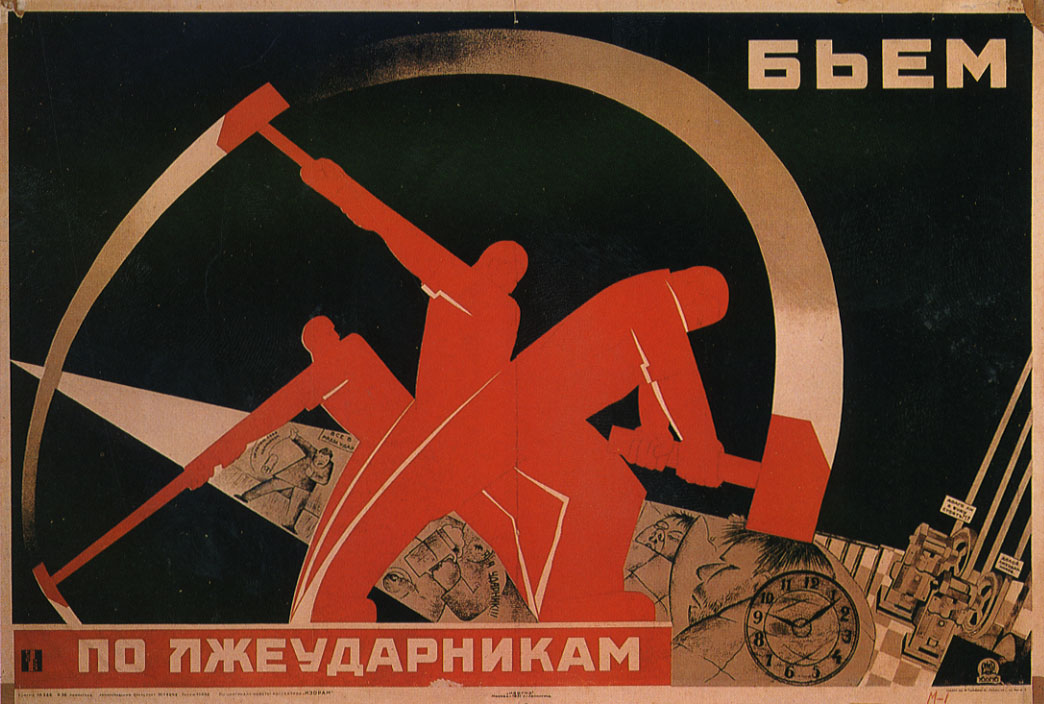
Most of the WTDH posters I have done only pull inspiration from an era. This one on the other hand was much more directly inspired from this poster: Poster.
Don’t get me wrong, there are some awesome posters from this movement, but I was terribly fond of this one known only as “Fighting Lazy Workers,” artist unknown. It exemplifies the simplicity of the era’s lines and shapes (much better than mine at least).